Before the LED Wall: Public Screens in the Projection Era
Public screens in the projection era show how rooms, temporary surfaces, and building facades shaped shared viewing before LED walls became familiar.
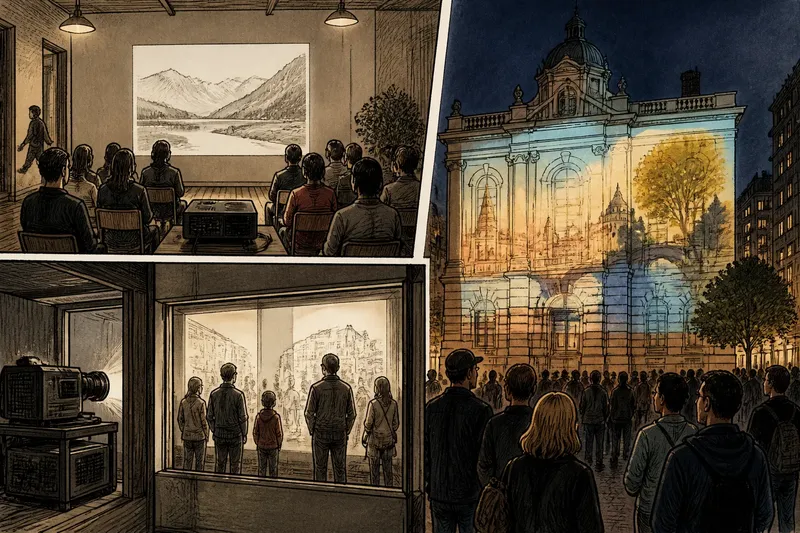
Public screens in the projection era depended on a beam of light, a receiving surface, and a place for viewers to stand or sit. In theaters, meeting rooms, exhibitions, and outdoor events, projection made images visible to groups without requiring a self-lit panel at the viewing surface.
That history has a specific scope: it concerns projection as one way of presenting shared images in public or communal settings, not a single, universal era before electronic displays. The arrangement varied with the venue. A theater directed attention toward a fixed screen; an outdoor projection could use a building facade and invite people to gather in an open space.
Projection arranged viewers around a shared surface
In a theater or assembly room, the projector sent light toward a screen at one end of the space. Seats, aisles, and screen formed a clear arrangement: people generally looked in the same direction, and the image had a defined edge. The room helped concentrate attention by limiting competing views.
This setup suited presentations, performances, and announcements intended for a gathered audience. An operator managed the projection, while viewers saw the same image at the same time. It was like setting one serving dish in the middle of a table: the shared object brought people’s attention together, but its position shaped where they looked.
A pale wall, stretched cloth, or purpose-made screen could receive a projected image if the surface and lighting made it visible. Whatever the material, viewers needed a usable line of sight from projector to surface and from surface to audience.
Front projection worked best when the beam stayed clear
In front projection, the projector and viewers were on the same side of the screen. The projector could sit behind or among the audience and send light toward the surface they faced. In a room, this could turn a blank wall into a shared display without a permanent screen installation.
The arrangement had a practical drawback: anyone crossing the beam could cast a shadow. The projector also needed a position that did not block the audience or intrude on the image. A room with manageable lighting and a settled audience suited this setup better than a passage where people continually crossed the viewing path.
Imagine a neighborhood group planning a talk in a community hall with a bare, light-colored wall. They place chairs facing the wall, set the projector behind the last row, and leave the central aisle clear. The expected result is a defined viewing area, though someone walking through the beam could still interrupt the image.
Rear projection kept equipment behind the screen
Rear projection placed the projector behind a translucent screen, with viewers on the other side. This kept the beam and equipment out of the audience’s direct path and reduced interruptions from people crossing the beam. The screen could appear like a window set into a partition.
This arrangement suited kiosks, exhibitions, and enclosed public settings where people approached the image from a designated side. It required usable space behind the screen and a material that transmitted light. If a temporary gathering had no room for equipment behind the screen, front projection could make better use of the available space.
The choice depended on the site as much as the image. Space behind a display favored rear projection when the audience’s side needed to stay clear. A wall facing a seated group could make front projection the simpler fit.
Building projections made architecture part of the display
Projecting onto a building changed the audience arrangement. Rather than seating people in a room, an event could use a facade as a visible landmark and draw viewers into a plaza, street, or courtyard. The building provided the surface; the open space around it became the viewing area.
This approach suited events and civic displays intended for an outdoor audience. It also made the image less controlled: viewers could arrive at different times, stand at different angles, or gather at varying distances. Windows, surface texture, nearby lighting, and the facade’s shape affected the result.
A building could not be turned to face the crowd like a portable screen. The projection had to work with the architecture and the available public space. A broad facade with room for people to stop offered a different setting from a narrow wall beside a busy route.
How did projection choices shape public viewing?
When did front projection make sense?
Front projection suited a room where the audience could face one surface and the projector could sit without blocking the view. The beam needed to remain clear, so a busy crossing route could disrupt the image.
When did rear projection fit better?
Rear projection made sense when viewers needed an unobstructed approach and there was space behind a translucent screen. A site without a protected equipment area on that side made the arrangement less practical.
Why project onto a building facade?
A facade could make a building a shared landmark for an outdoor audience rather than requiring viewers to sit in rows. The surrounding space still needed to accommodate people without interfering with ordinary movement through the area.
What shaped the choice of projection arrangement?
Audience sightlines, ambient light, foot traffic, the available surface, and the projector’s position all mattered. The venue and any applicable local rules or equipment instructions also shaped what could be used.
Public screens in the projection era tied images to places
Projection linked a light source, a receiving surface, and an audience positioned to connect the two. Front projection gathered people in front of a screen; rear projection placed equipment behind it; facade projection made architecture and nearby open space part of the display.
Public screens in the projection era are best understood through those relationships, rather than as a single stage in a simple march toward newer equipment. The site helped determine who could see the image, where they gathered, and whether the display belonged in a room, behind a screen, or on a city building.